Zootopia (2016) is a film that, on paper, should not have worked. A buddy-cop animated film about a rabbit and a fox solving a mystery in an anthropomorphic animal city, where the entire premise rests on a metaphor about prejudice and stereotyping that could easily collapse under its own weight. It’s the kind of movie that needed a charismatic, world-weary, emotionally-grounded co-lead to anchor everything else. That co-lead is Nick Wilde.
Nick Wilde is voiced by Jason Bateman in what might be the best voice performance of his career, which is saying something for an actor with Arrested Development and Ozark on his resume. He’s also, structurally, the character that makes Zootopia’s whole thematic argument work. Judy Hopps is the protagonist. Nick Wilde is the soul of the movie.
Below, the case for Nick Wilde as one of Disney’s best modern characters, plus everything to know: his backstory, his voice actor, his iconic green Hawaiian shirt, his relationship with Judy, and why his character arc is one of the most quietly affecting in Disney Animation’s recent history.
The Basics

Nicholas Piberius “Nick” Wilde is a red fox and the deuteragonist of Disney’s 2016 animated film Zootopia. He’s voiced by Jason Bateman as an adult and by Kath Soucie in childhood flashback scenes. The film was directed by Byron Howard and Rich Moore (co-directed by Jared Bush) and won the 2017 Academy Award for Best Animated Feature.
Nick starts the film as a small-time scammer working with his fennec fox partner Finnick, hustling marks across Zootopia. By the end of the film, he’s a police officer at the Zootopia Police Department, partnered with Judy Hopps in what is now one of Disney’s most beloved animated character pairings.
🦊 Nick Wilde at a Glance
- Full name: Nicholas Piberius “Nick” Wilde
- Species: Red fox
- Voice: Jason Bateman (adult), Kath Soucie (child)
- Films: Zootopia (2016), Zootopia+ (2022), Ralph Breaks the Internet (2018, cameo), Zootopia 2 (2025)
- Directors: Byron Howard and Rich Moore
- Studio: Walt Disney Animation Studios
- Job: Small-time scammer turned ZPD officer
- Partner: Finnick (fennec fox accomplice in early film), later Judy Hopps (ZPD partner)
- Iconic look: Green Hawaiian shirt, striped tie, gray pants
Why Jason Bateman’s Voice Performance Is So Important
Jason Bateman as Nick Wilde is one of the most successful voice castings in modern Disney Animation history. The choice was inspired and the execution is perfect.
Bateman’s whole acting persona is built around understated dry delivery, slightly cynical worldviews, and the ability to land genuine emotional moments without breaking out of that detached register. Arrested Development’s Michael Bluth (2003-2019) was the original template. Ozark’s Marty Byrde (2017-2022) was the dramatic version of the same archetype. Bateman has spent his whole career playing variations of “smart, weary, slightly resigned man who knows things won’t go his way but soldiers on anyway.”
This is exactly the right voice for Nick Wilde. The character needs to be:
- ✅ Smart enough to outwit Judy without being intimidating. Bateman’s intelligence-without-showboating delivery handles this perfectly.
- 💡 Cynical without being mean. The film needs us to like Nick even when he’s hustling people. Bateman’s underlying warmth makes the character sympathetic.
- 🔥 Capable of genuine emotional vulnerability when the script asks for it. Bateman has the dramatic range to deliver the film’s emotional beats without becoming saccharine.
- ✅ Believably world-weary at age 32 (Nick’s stated age). Bateman’s slightly tired delivery sells the character’s “I’ve seen everything and I’m tired” energy.
What’s especially notable is how Bateman doesn’t do a “voice acting voice.” He plays Nick the way he’d play a live-action character. The performance is naturalistic, conversational, and unforced. Most voice acting in Disney films involves some degree of stylization. Bateman just plays Nick as himself, and it works because the casting is so precisely right.
Watch a Zootopia scene with the visuals muted and just listen to Bateman’s vocal performance. He gives the character a full emotional life. The smug confidence, the moments of genuine surprise, the quiet hurt when his guard drops. It’s all there in pure audio.
The Character Arc That Carries the Film

Nick’s character arc is the film’s emotional spine. The arc has three movements:
Phase 1: The Hustler (Act 1)
When we meet Nick, he’s running a popsicle hustle with Finnick. He’s clearly intelligent, clearly capable, and clearly chosen to operate outside the system because he believes the system has no place for him. The film signals this immediately. Nick isn’t dumb or lazy. He’s actively decided to be what he is because the alternative seemed impossible.
This is the version of Nick that most viewers initially expect to be the antagonist. The sly fox who tricks people. The cynical operator who can’t be trusted.
Phase 2: The Reluctant Ally (Act 2)
Judy blackmails Nick into helping her with her investigation. What starts as transactional becomes something else as Judy and Nick spend time together. Nick begins to trust Judy. Judy begins to trust Nick. The audience starts to see Nick beyond the hustler persona.
The pivotal flashback scene in this section reveals Nick’s backstory: as a child, he tried to join the Junior Ranger Scouts (the equivalent of Boy Scouts in Zootopia’s world), and was muzzled and mocked by the prey-species kids because he was a fox. The trauma shaped his entire worldview. He decided then and there that if everyone was going to assume he was a predatory threat, he might as well embrace it.
This scene is the film’s emotional core. Bateman plays the older Nick’s vulnerability with restraint. The pain is there, but it’s not dramatized. It’s just the fact that this is who Nick is and why.
Phase 3: The Believer (Act 3)
The film’s climax involves Judy delivering an inadvertent press conference that inflames anti-predator prejudice in the city, which triggers Nick’s deepest fears about being trapped in the system. He walks away from their partnership. The film’s emotional payoff comes when Judy returns, apologizes, and Nick decides to believe in her again.
The very last act sees Nick choosing to become a ZPD officer. Not because Judy convinces him. Because Nick himself has decided that the system can change and he wants to be part of changing it.
The arc works because Nick’s transformation isn’t a sudden epiphany. It’s a slow, hard-fought reconsideration of how he sees the world. Disney Animation rarely commits this deeply to character development in 100-minute features. Zootopia does it because the film’s whole thematic argument requires it.
The Iconic Look
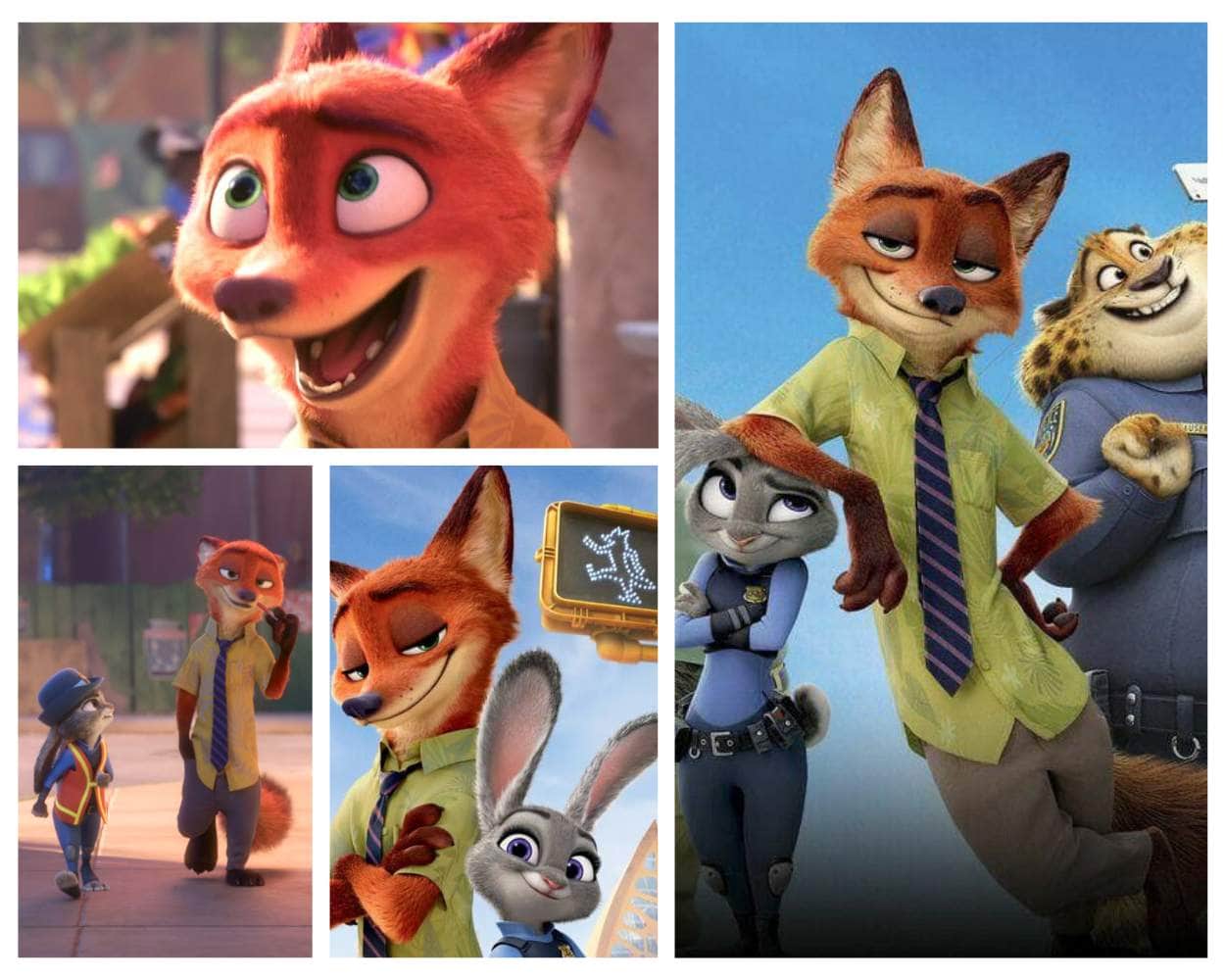
Nick’s outfit is one of the most distinctive character designs in modern Disney Animation:
- ✅ Green Hawaiian shirt with palm tree patterns — establishes him as deliberately casual, slightly out of place in formal settings, but stylish in his own way
- 💡 Striped tie in a brownish-purple color scheme — pairs absurdly with the Hawaiian shirt in a way that signals “I’m putting in effort, but I’m also above the dress code”
- 🔥 Khaki/gray pants — sharp enough to suggest he cares about looking presentable, casual enough to suggest he won’t conform
- ✅ The whole ensemble looks like a guy who’s trying to project respectability while signaling that he’s not bought into the system
The outfit is a thesis statement. Nick wants to be taken seriously but refuses to dress in the conventional ways the world expects. His clothes are his rebellion, his identity, and his disguise all at once.
When he transitions to the ZPD uniform at the film’s end, the audience can feel that he’s chosen to set aside his protective outfit for something he’s committing to. The visual transition is one of the film’s most quietly powerful moments.
The Judy-Nick Dynamic
The Judy Hopps-Nick Wilde partnership is one of Disney Animation’s best modern character pairings. The dynamic works because the writers (Phil Johnston and Jared Bush) gave both characters genuine flaws, complementary strengths, and a believable relationship arc:
- ✅ Judy is idealistic. Nick is cynical. They balance each other.
- 💡 Judy is a planner. Nick is improvisational. Different problem-solving approaches.
- 🔥 Judy underestimates the world. Nick underestimates himself. Their friendship is mutual recalibration.
- ✅ Judy thinks in terms of right and wrong. Nick thinks in terms of survival and pragmatism. The film respects both worldviews.
What’s notable is that the film deliberately avoids making them a romantic couple, despite the buddy-cop genre’s typical conventions. The Judy-Nick relationship is portrayed as an intense, intimate, life-changing friendship. They’re partners in the full sense of the word, but the film doesn’t reduce that to romance. This was a deliberate choice by the filmmakers and remains one of the more interesting decisions in modern Disney Animation. Fans have shipped them ever since.
Finnick: The Other Side of Nick’s Life
Nick’s pre-film life is connected to Finnick, the fennec fox who plays his “child” in their early-film popsicle hustle. Finnick is voiced by Tommy “Tiny” Lister (the late character actor known for Friday and various roles), and the contrast between Finnick’s tiny adorable appearance and Lister’s deep, gruff voice is one of the film’s best running jokes.
Finnick and Nick clearly have a working partnership that predates the film. The implication is that Finnick is the version of life Nick chose for himself when he gave up on legitimate paths. The character functions both as comic relief and as a glimpse of what Nick’s life looks like outside the relationship with Judy.
Finnick doesn’t show up in the film’s third act. The implication is that as Nick chooses a new path, the Finnick partnership necessarily ends. That choice has consequences. Old life, old friends, old hustles, all left behind for the new direction.
The Best Nick Wilde Quotes
Bateman’s delivery makes these lines hit:
- ✅ “It’s called a hustle, sweetheart.” The signature smug-meets-vulnerable Nick Wilde line. Establishes his entire personality in one sentence.
- 💡 “Never let ’em see that they get to you.” Nick’s life philosophy, delivered as a casual lesson to Judy. Holds the entire emotional weight of his backstory underneath the casual line reading.
- 🔥 “You can only be what you are.” The internal belief Nick has to overcome to complete his arc. He says it cynically. The film proves him wrong.
- ✅ “For what? Hwurting your fweewings?” The mocking imitation of Judy’s emotional moment. Pure deflective sarcasm.
- 💡 “You should have your own line of inspirational greeting cards, sir.” The Nick Wilde response to anything earnest. Becomes a meaningful character moment when his deflective sarcasm finally cracks.
Where Nick Wilde Fits in the Larger Franchise
Nick has appeared in:
- ✅ Zootopia (2016) — main appearance, with Jason Bateman voicing
- 💡 Ralph Breaks the Internet (2018) — brief cameo
- 🔥 Zootopia+ (2022) — Disney+ shorts anthology series
- ✅ Zootopia 2 (2025) — November 2025 sequel film, with Jason Bateman confirmed to return
The Zootopia 2 trailer (released in early 2025) shows Nick and Judy investigating a new case involving an unexpected witness — a reptile that’s mysteriously appeared in Zootopia, despite reptiles not being part of the city’s mammal population. The sequel is expected to further develop both characters and their partnership.
Why He Endures
Nick Wilde is one of Disney Animation’s best modern characters because he checks all the harder boxes:
- ✅ He has a believable inner life. Nick exists beyond his role in the plot. His backstory, opinions, and emotional history feel earned and real.
- 💡 He’s funny in a way that matches his character. Nick’s humor is always character-driven. It comes from his specific cynicism, his specific intelligence, his specific defensive deflection. It’s never just generic comedy.
- 🔥 The voice performance is essential. Jason Bateman makes Nick distinct. No other actor could have voiced this character. The performance is so specific it’s hard to imagine a recasting.
- ✅ The arc is genuinely affecting. Nick’s transformation from cynic to believer is one of Disney Animation’s best character journeys. It earns every emotional beat.
- 💡 He represents something real. Nick is the character who’s been told he can only be one thing for so long that he started believing it. His choice to believe otherwise is the kind of resonant arc that audiences relate to viscerally.
Zootopia works as a film because Nick Wilde gives it an emotional anchor. Judy is the protagonist who drives the plot. Nick is the character whose choices give the plot meaning. The film’s message about prejudice and self-determination lands because Nick lives that message on screen.
Watch Zootopia again with attention to how much of the film’s weight is carried by Nick’s facial expressions, his tone of voice, his quiet moments of recalculation. He’s doing more work than the script gets credit for. Jason Bateman’s performance is the kind of voice acting that should have been in Oscar conversation but wasn’t because Best Animated Feature doesn’t honor voice work the way it should.
Nick Wilde is the best part of Zootopia. The fact that Judy gets top billing doesn’t change that. The film succeeded because Nick Wilde existed to make it work.